Nvidia
Trump Called Nvidia's Jensen Huang During an All-Hands
Trump phoned Jensen Huang mid all-hands, per Wired — capping 36 hours of a $96.2B quarter, Nvidia's first PAC, and a $13B Hugging Face deal.
 Marcus Yuen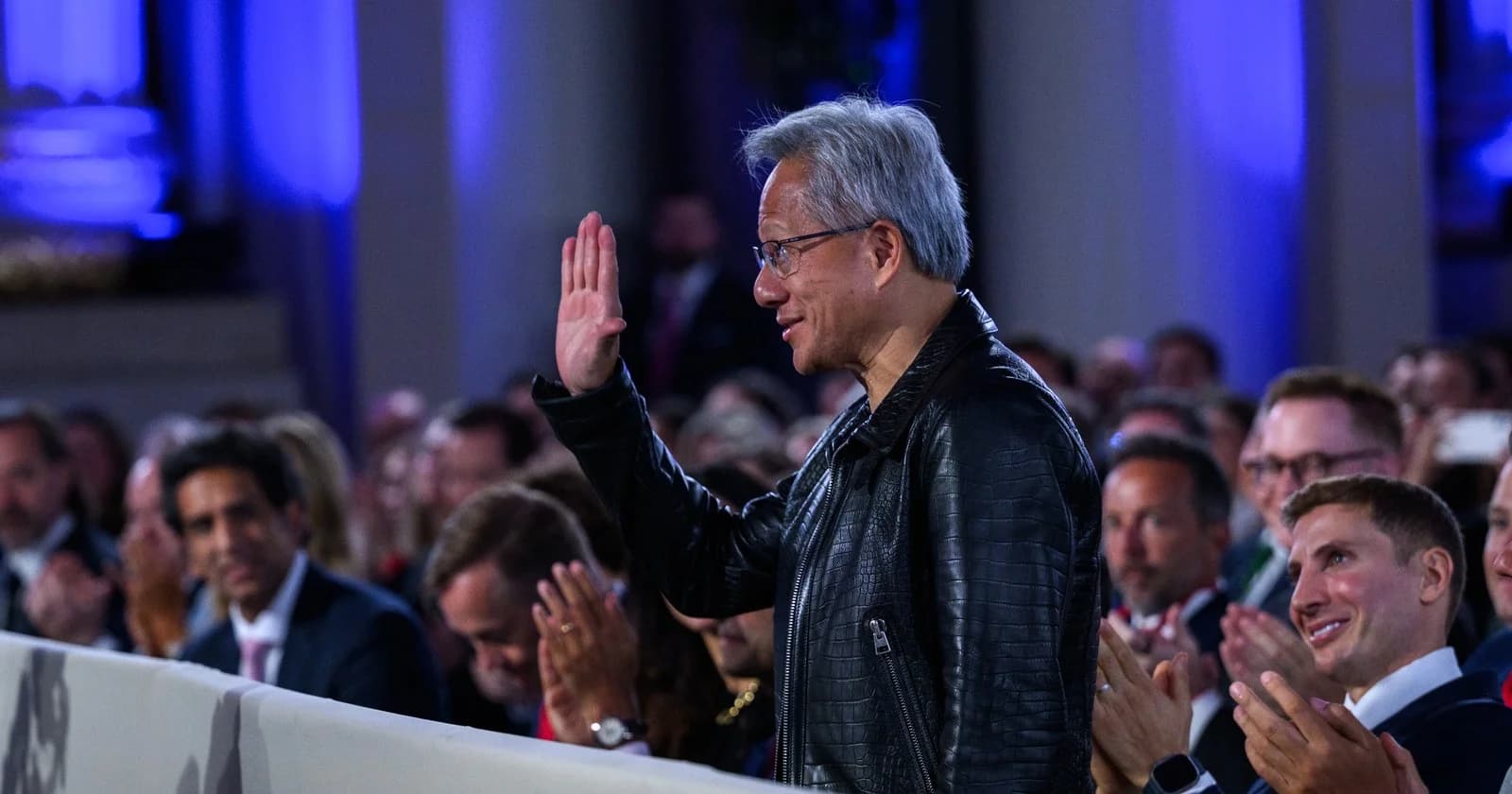
Somewhere in the middle of Nvidia's all-hands meeting last Thursday, the President of the United States called the CEO's cell phone, and the CEO picked up.
That is the scene reported by Wired, citing three sources who witnessed it. Jensen Huang was on stage at Nvidia's Santa Clara headquarters, running the company's usual format, presenting and taking questions in front of in-person staff while thousands more watched a livestream, when his phone rang mid-meeting. He stepped aside to take it. Staffers could hear Donald Trump's unmistakable voice bleeding through Huang's still-live onstage microphone, though not what he was saying. In under a minute, Huang was back on stage and the meeting resumed. Nvidia declined to comment; the employees, per Wired, were abuzz.
As an anecdote it is irresistible. As a data point about where Nvidia now sits in the American power structure, it is worth taking apart, because the call did not happen on a random Thursday. It landed in the middle of the most consequential 36 hours of Nvidia's year.
The 36 hours around the phone call
| When | What happened |
|---|---|
| Wednesday, Aug 26 | Nvidia reports Q2 revenue of $96.2 billion, up 106% year over year, and guides next quarter to $108 billion |
| Thursday morning, Aug 27 | Nvidia's PAC filing becomes public: NVPAC, its first-ever political action committee |
| Thursday, mid all-hands | Trump calls Huang on stage; staff hear his voice through the mic |
| Thursday, later | Trump posts congratulations on Truth Social for Nvidia's "incredible" quarter |
| Background all week | Reports that Nvidia has agreed to acquire Hugging Face for roughly $13 billion, a deal that would need antitrust clearance |
Take the pieces in order.
The quarter. Nvidia's fiscal second quarter, ended July 26, was $96.2 billion in revenue, up 18% sequentially and 106% from a year ago, with data center revenue of $89 billion making up 92% of the company. Gross margin held at 75%, the company returned a record $26 billion to shareholders in the quarter, and guidance for the current quarter is $108 billion, plus or minus 2%. On the earnings call the company went further still, pointing to roughly 70% growth for fiscal 2028 even with supply constraints, a forecast that presumes the AI buildout keeps accelerating through the next presidential budget cycle. Stack the last five quarters end to end and the pattern is the story: $46.7 billion, $57.0 billion, $68.1 billion, $81.6 billion, $96.2 billion. Over those four sequential steps Nvidia has added an average of $12.4 billion in net new quarterly revenue per quarter, which means that roughly every 90 days, Nvidia bolts a Netflix-sized quarter of new revenue onto itself.

At that run rate, the arithmetic of the interruption itself is absurd: $96.2 billion over a 13-week quarter works out to about $730,000 of revenue per minute, so the sub-minute presidential phone call spanned roughly three-quarters of a million dollars of revenue-time.
The PAC. The same Thursday morning, it emerged that Nvidia had filed to create NVPAC, formally the Nvidia Corporation Employees Federal Political Action Committee, an employee-funded vehicle through which eligible staff can contribute up to $5,000 toward donations to federal candidates, per The Hill. The reversal is the notable part: Nvidia's corporate policy had explicitly prohibited contributions to parties, candidates, or PACs, and the company reported zero organizational political spending in recent cycles. Google, Microsoft, and Amazon have long run similar employee PACs, and Anthropic launched one in April. Nvidia held out until the quarter it started guiding to $108 billion.
The friction. The warmth of a congratulatory phone call sits on top of real disagreements. As Wired notes, Nvidia and the administration have not always aligned on how to regulate open AI models or on sales of advanced chips to China, the single largest overhang on Nvidia's addressable market. Huang has spent much of the past two years shuttling to Washington to argue Nvidia's side of both, and he has sat in closed-door meetings with Trump before; what changed Thursday is that the relationship rang through, audibly, in front of the whole company. And the reported Hugging Face acquisition, at a price above $13 billion, would put Nvidia's next big move squarely in front of the administration's antitrust regulators. When your merger reviewers, export licensers, and model regulators all work for the man on the phone, you answer the phone.
The call is the org chart now
There is a useful comparison from earlier in the week, one wall over on this site: Apple, whose CEO transition takes effect Monday, restructured its leadership so that the outgoing chief executive's full-time job becomes, in Apple's own words, engaging with policymakers. Apple needed to split the roles of running the company and managing Washington into two people. Huang is currently doing both from one phone, in one leather jacket, sometimes literally mid-meeting.
That concentration is Nvidia's strength and its exposure. No other company's fortunes are so tightly coupled to decisions made in Washington: export rules set the size of its China business, AI policy shapes its customers' spending, antitrust decides whether it can buy the platforms its developers live on. A president who calls to say congratulations is also a president who can call about something else. NVPAC, the lobbying itinerary, and the growing Washington operation are Nvidia building institutional plumbing for a relationship that, as of last Thursday, still runs person-to-person, on a cell phone, in front of the whole company.
The employees buzzing about it afterward got the significance about right. For three decades the tech industry's founding myth was distance from government, garages, not auditoriums named after Treasury secretaries. The most valuable chip company on earth just showed its entire workforce, live, that the White House has the CEO on speed dial, and vice versa. Nobody even paused the meeting.
Cover: Jensen Huang at the White House AI Summit in Washington (Official White House photo, public domain, via Wikimedia Commons). Chart: Tech Forum from Nvidia earnings releases.
About the author
Marcus Yuen
Marcus Yuen is a senior correspondent at Tech Forum covering venture capital and the Asia-Pacific tech sector, with a focus on hardware startups and funding-market dynamics.
Keep reading
More from Tech Forum
Boost Security Acquires Korbit.ai to Enhance AI Security
Boost Security's acquisition of Korbit.ai and SecureIQx aims to strengthen AI-native security by integrating advanced code review and reachability…
Marcus Yuen / October 18, 2026
IVADO Postdoctoral Funding Program 2027 Launch
IVADO's postdoctoral funding program launches its 2027 cycle, offering 10 prestigious fellowships of $80k annually for a period of two years.
Marcus Doyle / October 17, 2026
What PIPEDA Means for Your Google Maps Timeline Data
Google Maps Timeline now lives on your phone. What PIPEDA covers, what Canadian regulators have ruled on location data, and how to keep your history private.
Marcus Doyle / October 17, 2026