News
Starbase's Prometheus Statue: Atelier Missor's $1M Gift
A Paris foundry spent about $1 million of its own money on a fifty-foot bronze Prometheus and gave it to SpaceX's Starbase uncommissioned. The sculptor is the patron, which inverts how monuments get built.
 Gavin Foss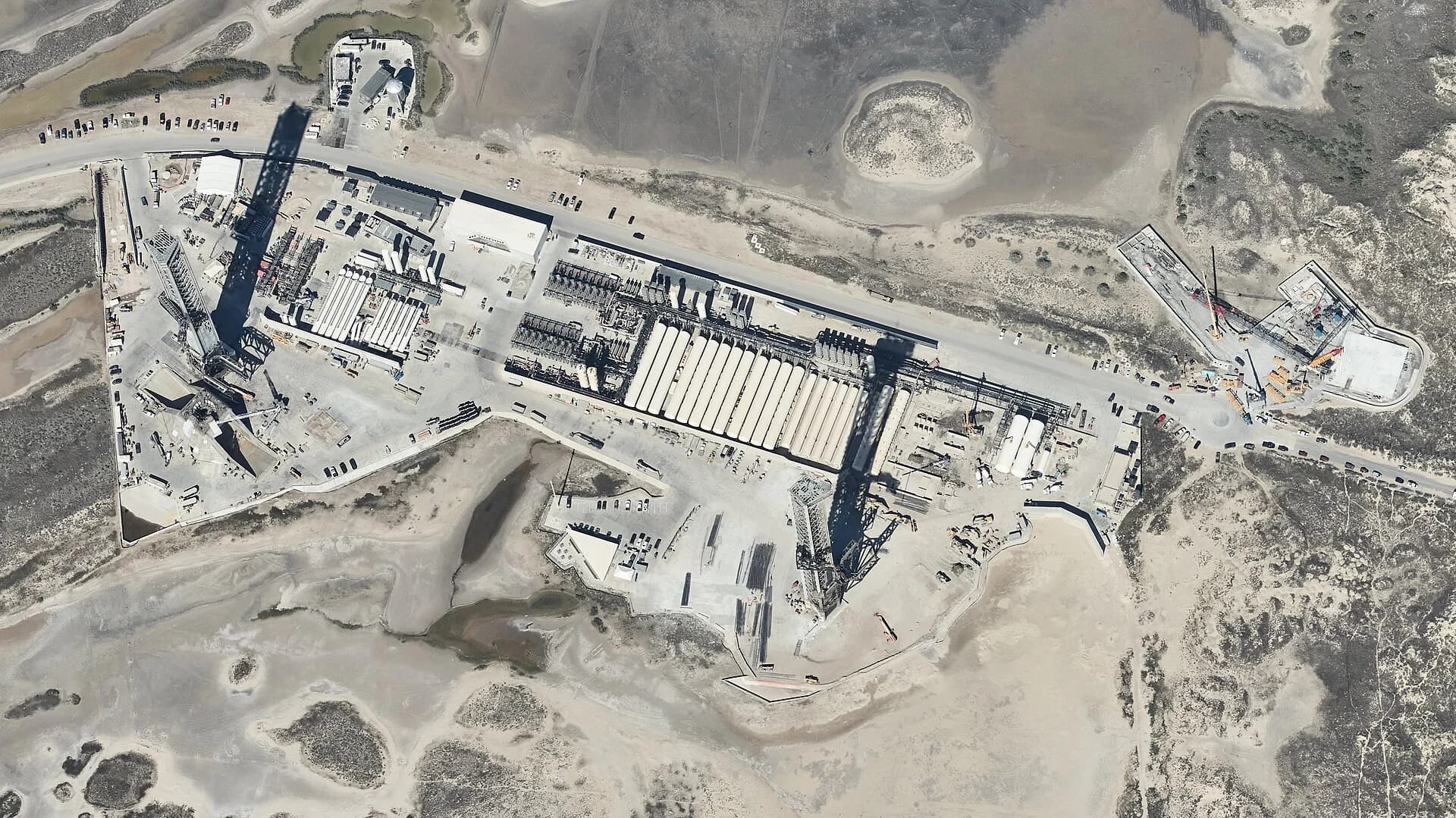
A French foundry has spent roughly a million dollars of its own money on a fifty-foot bronze Titan, shipped it across the Atlantic in pieces, and is bolting it together on the edge of a rocket range in south Texas. Nobody at SpaceX asked for it. Nobody at SpaceX is paying for it. It is a gift.
Atelier Missor, a classical foundry outside Paris run by the brothers who go by Missor and Massoud, is assembling a monumental Prometheus on private land just beyond the city limits of Starbase, the company town SpaceX incorporated around its Starship launch site. The sections were cast in France. The figure stands with a torch raised. The studio has been explicit that the work is independent, neither commissioned nor funded by SpaceX or Elon Musk, and reporting puts the bronze at around $1 million.
In a few days, Prometheus will stand 50 ft tall, holding high the torch of the West. Starbase, Texas.
— Atelier Missor (@AtelierMissor_) August 9, 2026
A private workshop spending roughly a million dollars to give an unsolicited fifty-foot monument to a company that never requested it is not patronage in any direction the art world recognizes, and that inversion is the story.
Monuments normally run the other way. A city, a state, a donor or a corporation commissions the work, approves the maquette, and pays the invoice. Here the sculptor is the patron. The recipient found out the way everyone else did.
The atelier is about five years old. Missor describes himself as a self-taught sculptor, and the workshop's stated project is to revive Greco-Roman statuary as a living practice rather than a museum category, working in bronze and titanium and choosing mythological and historical subjects over living ones. The brothers have talked about a twenty-metre titanium version as the longer-term ambition, titanium for the reason you would expect: it does not corrode and it is very hard to destroy.
Tech has campuses, not monuments
Fifty feet is roughly 45 percent of the height of the Statue of Liberty's body, and that comparison is the point. The technology industry has spent forty years building the most valuable companies in history without ever building anything a passerby would recognize as a monument.
It has produced architecture instead. Apple Park, the Googleplex, the Bay Area's long inventory of glass rectangles with a coffee bar and a climbing wall. Corporate art in tech is abstract by policy, because abstraction cannot be misread and therefore cannot embarrass anyone in a deposition. A curved steel form in a courtyard commits you to nothing.
A fifteen-metre man holding fire commits you to quite a lot, which may be exactly why it had to arrive as a gift. No general counsel signs off on this. No brand committee approves a naked Titan. The only way a monument like this gets built next to a launch site is if someone outside the company builds it and hands over the keys.
Prometheus was punished
The subject is not a neutral pick, and it is more double-edged than the people who paid for it seem to want.
Prometheus stole fire from the gods and gave it to humanity, and the gods chained him to a rock and sent an eagle to eat his liver every day forever. The myth is not a story about the glory of invention. It is a story about invention and its bill arriving together, which is why Mary Shelley subtitled Frankenstein "The Modern Prometheus" and did not mean it as a compliment.
Anyone raising this particular Titan next to a launch site is choosing the half about the gift. The other half comes with it. You do not get to install the fire without installing the eagle.
Why a Canadian tech reader should care
Canada has no equivalent. There is no monument to the Avro Arrow's engineers, nothing at the corner in Waterloo where RIM built the device that changed how the world handled email, no public sculpture that treats a technologist the way a nineteenth-century city treated a general. Our tech history lives in plaques and museum vitrines, at a scale that asks nothing of anyone.
That is partly a difference in temperament and partly a difference in confidence. Monuments are an argument that something is settled and worth remembering, and settling arguments in public is not a Canadian habit. But it is a real gap, and the Starbase Prometheus shows how cheaply it could be closed: one workshop, one seven-figure decision, no committee.
The statue will stand or it will not, and taste will do what taste does. What it has already accomplished is to make the question visible: what would the technology industry build if it were building for people who will never work there, never see the inside of the campus, and only ever see the thing from the road.
Cover image: NOAA emergency response imagery of the Starbase launch site, January 2026. Public domain.
About the author
Gavin Foss
Gavin Foss is the editor-in-chief at Tech Forum, covering the Canadian technology landscape with a focus on AI and emerging technologies. His technical depth and industry connections make him one of Canada's most respected tech journalists.
Keep reading
More from Tech Forum

Thin Air Labs Funding Catalyst Calgary Milestone
Discover the data-driven update on Thin Air Labs' Funding Catalyst Calgary milestone, achieving a remarkable $100M in non-dilutive funding.
Marcus Yuen / September 26, 2026
OPC OpenAI Privacy Findings: Canada Regulators' Joint Review
OPC OpenAI privacy findings summarize an extensive joint Canadian investigation into the data handling practices of ChatGPT.
Steph Moreau / September 25, 2026
Bell AI Fabric Sovereign AI Infrastructure Canada
Bell AI Fabric sovereign AI infrastructure Canada powers a landmark sovereign AI deal in Canada, linking data residency with national compute.
Gavin Foss / September 24, 2026