News
AI in Agriculture Tech in Major Canadian Cities 2026
News and data-driven analysis of AI in Agriculture Tech Across Toronto, Montreal, Vancouver, and Waterloo Corridors 2026.
 Derek Fung
The AI in Agriculture Tech Across Toronto, Montreal, Vancouver, and Waterloo Corridors 2026 is shaping up as a cross-country initiative with real-world implications for farming, food security, and rural economies. On May 12, 2026, the Government of Canada announced a sweeping push to scale artificial intelligence across industries, including agriculture, through the Sovereign AI Compute Strategy and the AI Compute Access Fund. The announcement, issued from Vancouver, underscored that 44 projects nationwide would share $66 million in funding to access high-performance computing resources, marking a concrete step toward turning AI research into scalable, farm-ready solutions. This development matters for growers, agtech startups, research labs, and policy makers alike as Canada’s four-city corridor strategy gains clearer funding signals and a broader recognition of agriculture as a critical domain for AI-powered productivity gains. The initiative signals not only a funding pivot but a governance and capability-building effort intended to keep Canadian agtech development anchored domestically while enabling scalable export opportunities. (canada.ca)
The four-corridor landscape—anchored by Toronto-Waterloo in Ontario, Montreal in Quebec, Vancouver on the West Coast, and a growing agtech presence in British Columbia’s Lower Mainland—has long been seen as a unique convergence of research talent, startup activity, and corporate investment. The government’s AI Compute Access Fund explicitly notes agriculture among the sectors set to benefit from compute-enabled AI product development, a signal that Canada’s agtech ecosystem is increasingly data- and compute-driven rather than purely lab-based. This trend aligns with the broader national AI strategy and the ecosystem-building work underway in 2026 across the four corridors, where universities, industry hubs, and venture networks are increasingly collaborating to turn AI breakthroughs into practical farming tools. The funding announcement also highlighted geographic distribution within the country, including eight BC projects and a set of other initiatives across Ontario, Quebec, and other provinces. (canada.ca)
Montreal’s Mila and Toronto’s Vector Institute—along with Waterloo’s robust AI ecosystem—remain core anchors in Canada’s AI for agriculture narrative. Mila’s Montreal-based research network continues to push AI-enabled biotechnology and data-driven farming insights, while Toronto’s Vector Institute and its network help connect academic advances to industry pilots in agri-food and supply-chain contexts. The four-corridor dynamic is further reinforced by the Toronto–Waterloo cluster’s scale and sophistication, which includes hundreds of AI-focused startups and a dense web of accelerators, industry partners, and talent pipelines. These hub ecosystems provide both technical depth and practical pathways for translating AI research into field-ready agricultural solutions, from precision irrigation to crop disease detection. In 2026, these centers remain focal points for cross-border collaboration, joint pilots, and the talent engine that powers Canada’s agtech ambitions. (mila.quebec)
Across the four corridors, sector participation is broadening. In addition to traditional AI labs and software firms, agriculture-related projects are increasingly attracting attention from biotechnology researchers, agritech startups, and farming co-ops that see AI-enabled data analytics, remote sensing, and automation as critical levers for productivity. The government’s May 12, 2026 release explicitly states that the funded projects span life sciences, health care, energy, advanced manufacturing, agriculture, finance, natural resources, and transportation, highlighting the sector’s role within a larger AI-enabled economy. This cross-sector approach reinforces the view that AI in Agriculture Tech Across Toronto, Montreal, Vancouver, and Waterloo Corridors 2026 is not a single-use case but a broad, ecosystem-wide effort to unlock value across farm operations, processing, and rural employment. (canada.ca)
Opening with the news, the federal program’s emphasis on compute access sets the stage for practical AI deployments in farming. But the four-corridor context matters because it frames how compute capabilities, research excellence, and industry networks combine to accelerate agtech pilots. In Vancouver, the government’s release noted eight projects funded in British Columbia, underscoring the region’s growing role in AI-enabled agriculture tools—from yield optimization and disease forecasting to sensor-driven irrigation strategies. The funding’s intent is explicit: reduce the cost and friction of training AI models at scale so startups and existing agtech players can push products from prototype to field-ready implementation. This is a concrete inflection point for Canada’s agricultural technology scene as it enters a more compute-enabled, data-driven growth phase. (canada.ca)
Section 1: What Happened
Announcement Details
The May 12, 2026 news release from Innovation, Science and Economic Development Canada (ISED) placed agriculture front and center in a broader national AI compute strategy. The AI Compute Access Fund, part of the Sovereign AI Compute Strategy, is designed to offset the heavy compute costs that often limit AI development for small and medium-sized enterprises. The government reported that 44 projects nationwide will share $66 million, with a clear emphasis on enabling AI products and services that can be scale-ready for Canadian markets. Agriculture was explicitly named among the sectors benefiting from this funding, signaling a policy shift that treats farming technology as a strategic domain for AI investment and industrial adoption. The press release also noted that the initiative builds toward a longer-term objective: keeping more value, IP, and high-skilled jobs within Canada as AI technologies mature. (canada.ca)
Photo by Dan Meyers on Unsplash
Montreal, Toronto, Vancouver, and Waterloo all stand to benefit from this compute-enabled acceleration. The fund’s geographic distribution included a significant allocation to British Columbia (BC), with $16.8 million supporting eight BC projects. While the release highlighted national breadth, it underscored local impact by pointing to agtech and other sector-specific pilots that rely on robust compute power to train, validate, and deploy AI models in real-world environments. That explicit inclusion of agriculture among funded sectors is especially meaningful for corridor ecosystems that seek practical application of AI research in farming contexts, from precision agronomy to supply-chain optimization. (canada.ca)
Ministerial leadership and program governance played a visible role in the announcement. The release quotes The Honourable Evan Solomon, Minister of Artificial Intelligence and Digital Innovation and Minister responsible for the Federal Economic Development Agency for Southern Ontario, emphasizing that access to compute power is foundational to building AI-based products here in Canada. The program is designed to be evaluated on technical feasibility, commercialization potential, risk, and anticipated benefits to the country, with additional offers run as assessments are finalized. The funding model thus projects a pipeline of ongoing opportunities for agtech teams to compete for compute credits and accelerate their AI-enabled farming solutions. (canada.ca)
Timeline and key dates anchor the event in a concrete sequence. The call for applications closed on July 31, 2025, a date that policy observers and startup teams tracked closely as the moment when Canada signaled a serious push toward domestic AI compute capacity for commercial use. The May 12, 2026 release marks the public unveiling of results and allocations, including $16.8 million in BC and a nationwide set of 44 projects. The program’s organizers reiterated that more offers would be made as assessments continued, signaling a continuing cadence of funding as more compute needs and project milestones emerged. In short, this is not a one-off grant but the initial tranche of an ongoing effort to knit together AI research capacity and industrial adoption—an effort that corridors like Toronto-Waterloo, Montreal, and Vancouver are well positioned to lead. (canada.ca)
Key participants and geographic footprint provide a snapshot of who and where. The government’s release highlighted that the funded projects span multiple sectors, including agriculture, and noted that the fund’s design aims to support projects that can build and scale AI products here in Canada. The funding approach—combining government resources, rigorous project assessment, and a focus on domestically rooted AI development—helps explain why the four corridors matter. In particular, the program’s BC allocation demonstrates that agtech pilots have both national and regional relevance, with corridor players in BC, Ontario, Quebec, and beyond having opportunities to access compute that can unlock agricultural productivity innovations in field operations, greenhouse management, and processing optimization. (canada.ca)
Key Dates and Participants
- July 31, 2025: Applications closed for the AI Compute Access Fund. (canada.ca)
- May 12, 2026: Government announces 44 funded AI Compute Access Fund projects totalling $66 million; eight BC projects accounted for a share of $16.8 million; agriculture identified as a key sector. Vancouver, BC served as the release backdrop. (canada.ca)
- Ongoing: Additional funding offers to be announced as assessments wrap up, indicating a continuing program cadence. (canada.ca)
Geographic Footprint and Agriculture Focus
The May release specifically called out agriculture among the sectors benefiting from the AI Compute Access Fund. This is a practical signal to agtech startups and farming operations that the federal government views AI-enabled farming tools as core to Canada’s economic strategy. The BC allocation underscores a regional emphasis on applying AI to farming challenges across coastal and inland agricultural ecosystems, from greenhouse management and soil analytics to pest forecasting and yield optimization. The emphasis on compute access is especially relevant for data-intensive domains in agriculture, where models rely on high-resolution sensor data, climate information, and real-time field observations to inform decisions. The program’s cross-country footprint aligns with corridor-based ecosystems that combine university research, private sector innovation, and public funding to push agtech pilots from lab concepts to field deployments. (canada.ca)

Photo by Steven Weeks on Unsplash
Section 2: Why It Matters
Agricultural Productivity and Rural Resilience
AI-enabled agtech has the potential to lift yields, reduce input costs, and improve resource-use efficiency across Canada’s farm regions. The Government of Canada’s funding release explicitly noted agriculture as a beneficiary sector, signaling a policy commitment to applying AI compute power to real-world farming challenges. For farmers, this could translate into practical tools such as real-time irrigation optimization, pest and disease forecasting, soil moisture mapping, and yield prediction models that help with planning and risk management. Such tools can improve farm profitability and resilience in the face of climate variability, helping rural communities maintain employment and economic vitality in decades where farm income and supply chains face heightened volatility. The government’s emphasis on “compute power” as a core infrastructure for AI economy reinforces the shift toward data-driven farming, where sensors, drones, and edge devices feed AI models that guide day-to-day decisions on the field or in the greenhouse. (canada.ca)
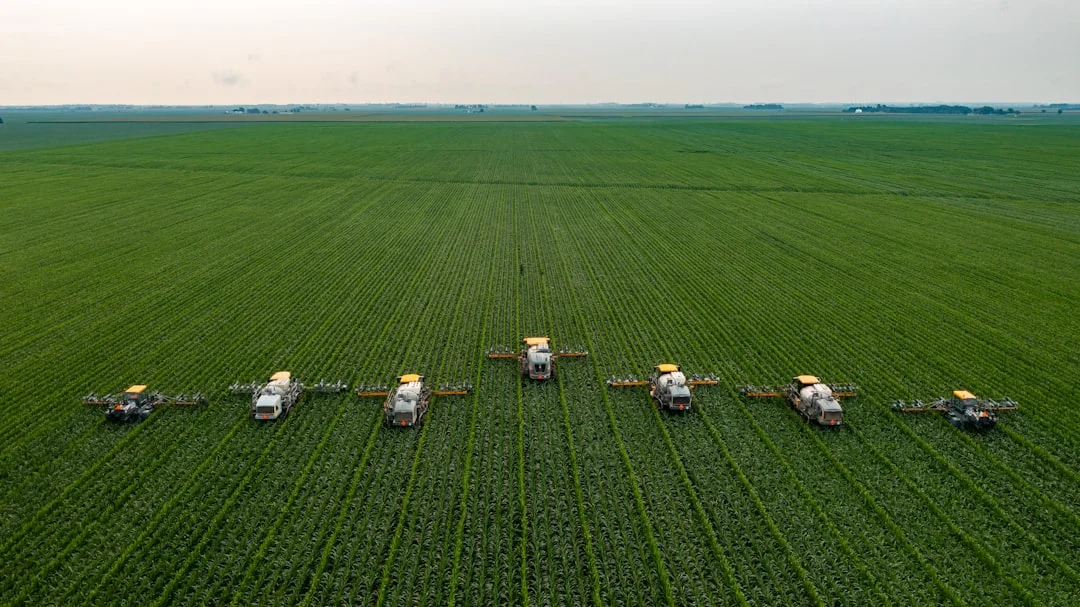
Photo by James Baltz on Unsplash
Cross-corridor collaboration amplifies the impact. The four corridors—Toronto-Waterloo in Ontario, Montreal in Quebec, Vancouver in British Columbia, and the broader Canadian agtech ecosystem—are already known for their complementary strengths: deep AI research clusters (Mila in Montreal; Vector Institute and the Schwartz Reisman campus in Toronto; Waterloo’s accelerators and AI talent pools), strong industry networks, and access to capital. The JETRO report on Canada’s risk capital landscape explicitly identifies the Toronto–Waterloo corridor as the largest share of venture investment by deal value and volume, with Montreal and Vancouver also playing pivotal roles in AI, manufacturing, and agri-food technology. This regional distribution matters for agriculture because it creates dense environments for pilots, data-sharing networks, supplier relationships, and regulatory and governance learning. The four-corridor setup enables cross-pollination—academia in Montreal feeding agri-ML models, Toronto-Waterloo scaling field-ready solutions, Vancouver linking coastal farming with green-tech innovations, and Quebec’s ecosystem bridging biotech with agrifood applications. (jetro.go.jp)
Policy context and governance add staying power. Mila’s work in Montreal emphasizes the role of AI governance and responsible AI in bringing lab breakthroughs to real-world use, a critical consideration for agtech where data privacy, safety, and environmental impact are closely watched. The Pan-Canadian AI Strategy anchors national coordination, with regional hubs responsible for translating research into industrial adoption. This governance backdrop matters for agriculture because it helps ensure that AI-enabled farming tools meet safety, privacy, and ecological standards while remaining scalable across provinces and farm sizes. A strong governance framework can also facilitate data-sharing arrangements that are essential for training robust agricultural models—if farmers and researchers can participate in shared datasets, AI tools become more accurate and broadly applicable. (mila.quebec)
Economic implications and jobs. The government’s release explicitly ties compute-enabled AI to job creation and domestic economic value retention. The intended effect on the agriculture sector includes enabling agtech startups and established farming technology providers to bring more advanced AI-powered products to market, potentially shortening the cycle from ideation to deployment. This could create high-skilled roles in data science, AI engineering, and agritech systems integration, while also supporting jobs in product support, field implementation, and maintenance of AI-enabled equipment and analytics platforms. In a country where the Toronto–Waterloo corridor already hosts a large share of tech employment, adding robust agtech AI capabilities helps diversify the regional economy and deepen resilience across agricultural supply chains. (canada.ca)
Risks and considerations. While the funding and corridor advantages present opportunities, experts caution that AI adoption in agriculture must contend with real-world constraints, including data ownership, interoperability across hardware and software platforms, and the need for field-proven reliability. The JETRO report highlights broader Canadian market dynamics, such as regional clustering and the continuing role of public funding in sustaining early-stage innovation. For agriculture, these dynamics translate into a need for pilot programs that deliver measurable farm-level improvements and clear pathways to scale, as well as governance mechanisms that address data sharing, safety, and environmental impact. In addition, the capital markets narrative—where early-stage funding can be robust but late-stage financing can be more difficult—means that corridor ecosystems must work with government programs and corporate investors to ensure pilots reach scale domestically and, where appropriate, internationally. (jetro.go.jp)
Section 3: What’s Next
What’s Next for the Corridors
Over the next 12 months, agtech AI pilots—including those supported by compute-enabled funding—are expected to advance from concept to field pilots across diverse farming contexts. The immediate implication for Toronto, Montreal, Vancouver, and Waterloo is a more active pipeline of AI-enabled agritech projects that can demonstrate tangible gains in yield, resource efficiency, and crop health monitoring. The AI Compute Access Fund’s ongoing assessment process means additional projects will be announced as evaluators complete their reviews, creating a continuing cadence of opportunities for startups and established players alike. This incremental funding approach allows corridor ecosystems to test models in different climatic zones, crop types, and farming practices, expanding the dataset richness needed to generalize AI tools across Canada’s diverse farming landscape. (canada.ca)
Events to watch. Industry events and summits in 2026 will shape public perception and investor interest in agtech AI across the four corridors. In Toronto, the Ontario Centre of Innovation has been active in promoting innovation events that connect AI and agriculture stakeholders, with DiscoveryX and related forums serving as anchors for collaboration. The Saiwa AI Drone Solutions team highlighted its presence at DiscoveryX 2026 in Toronto, underscoring how applied AI and computer vision are transforming field operations in agriculture. These events signal a continuing emphasis on practical AI applications in farming, including drone-enabled scouting, autonomous field operations, and real-time decision-support tools for growers. (saiwa.ai)
Global and national context. Canada’s four-corridor strategy sits within a broader global AI and agtech trend, where compute power, data, and cross-institution collaboration are essential for bringing agricultural AI from a promising concept to a trusted, scalable tool on farms. The World Summit AI Canada and related conferences in Vancouver and Montreal reflect international interest in Canada’s AI ecosystem, including agriculture-related applications. While the immediate announcements focus on compute and ecosystem-building, the longer arc points toward more cross-border pilots, more public-private partnerships, and expanded data-sharing initiatives that could accelerate AI adoption in agriculture. (americas.worldsummit.ai)
What to watch in the next six to twelve months. Expect additional announcements on compute credits, new agtech pilots tied to the AI Compute Access Fund, and campus-industry partnerships that link MILA and Vector Institute researchers with farming cooperatives and agro-industrial firms. Government funding rounds often come in batches, so a follow-up round or companion programs targeting agtech data platforms, edge AI, and climate-resilient farming solutions could be announced, with priority given to cross-corridor collaborations that leverage Montreal’s biotech AI strengths, Toronto–Waterloo’s scale, Vancouver’s hardware and hardware-software integration, and Waterloo’s deep tech manufacturing and robotics capabilities. The ecosystem’s maturity will increasingly depend on the ability to translate lab-grade AI into field-ready, decision-grade tools for farmers, with a strong emphasis on reliability, governance, and measurable ROI. (mila.quebec)
What’s Next: Timeline and Next Steps
- Q3–Q4 2026: Follow-on AI Compute Access Fund announcements for additional agriculture-focused projects as assessments finalize and new compute slots open. These rounds will likely emphasize pilot deployments in diverse farming contexts across the four corridors. The government’s original guidance signals ongoing opportunistic funding as project milestones are achieved. (canada.ca)
- 2026–2027: Corridor-based collaborations expand, with Mila in Montreal, Vector Institute and U of Toronto ecosystems in Ontario, and Waterloo’s accelerator networks playing leading roles. Expect more joint pilots involving agtech startups, equipment manufacturers, and farm co-ops, with data-sharing frameworks and governance standards emerging to support scaling. The JETRO report and regional profiles underscore that corridor clusters are well-positioned to drive these cross-boundary initiatives. (jetro.go.jp)
- 2027 onward: Broader adoption of AI-powered farming tools across Canada, with potential export opportunities anchored by corridor-scale AI capabilities, farm data networks, and manufacturing partnerships in Waterloo’s manufacturing ecosystem and Vancouver’s hardware-forward agtech initiatives. The national AI strategy remains a guiding framework to ensure that agricultural AI deployments align with safety, governance, and environmental priorities while delivering tangible farmer outcomes. (mila.quebec)
Closing
The AI-enabled agriculture story across Toronto, Montreal, Vancouver, and Waterloo in 2026 is unfolding as a data-driven, policy-backed effort to accelerate practical farming technologies. Federal funding signals and corridor strengths are aligning to push AI from the lab to the field, with the potential to boost yields, reduce input costs, and strengthen rural economies across Canada. As pilots expand and governance frameworks mature, stakeholders should watch for measurable farm-level ROI, standardized data-sharing practices, and cross-corridor collaborations that translate AI research into reliable, scalable farming solutions. The four corridors’ combined depth—anchored by Mila’s Montreal AI leadership, Vector Institute’s Toronto presence, Waterloo’s deep-tech ecosystem, and Vancouver’s growing agtech activity—creates a compelling environment for AI in agriculture to move from promise to practice in the coming years.
To stay updated on AI in Agriculture Tech Across Toronto, Montreal, Vancouver, and Waterloo Corridors 2026, monitor government releases, corridor-based innovation hubs, and major agtech conferences. The convergence of compute power, academia, and industry across these Canadian corridors suggests that 2026 could be a pivotal year for field-ready AI farming tools and for the farmers who stand to benefit from them. (canada.ca)
About the author
Derek Fung
Derek Fung is a cybersecurity and cloud computing reporter at Tech Forum, covering the infrastructure that powers Canada's digital economy. His investigative reporting on security threats and cloud trends keeps IT leaders informed and prepared.
Keep reading
More from Tech Forum
OpenAI ChatGPT Privacy Findings Drive Canadian Action
OpenAI ChatGPT privacy findings spark a strong Canadian regulatory response, driven by comprehensive data-driven insights and analysis.
Marcus Doyle / September 14, 2026
G+D Launches AI Hub in Montreal for Secure AI Development
Giesecke+Devrient (G+D) has launched its AI Hub in Montréal at Mila, investing CAD 80 million over five years to create 60 specialized AI roles,…
Steph Moreau / September 13, 2026

OPC Ruling Finds X Corp. Violated Privacy Laws
The Office of the Privacy Commissioner of Canada ruled that X Corp. and its subsidiary X.AI failed to protect personal data in their Grok AI platform,…
Marcus Yuen / September 12, 2026