Analysis
SoMark Releases Code and Weights for OXR, a 1.3B Document Parser Built for Self-Hosted RAG and Agent Pipelines
SoMark released the code and weights for OXR, a 1.3B document parsing model for self-hosted RAG and agent pipelines, with Markdown and JSON output.
SHANGHAI, China, October 20, 2026. SoMark today released the code and weights for OXR (Optical Everything Recognition), a 1.3-billion-parameter document parsing model that converts PDFs and document images into Markdown or JSON with layout coordinates and reading order. The release targets organizations that need structured document data for retrieval-augmented generation (RAG) and AI agents and want to keep their files on their own hardware.
OXR runs on a single NVIDIA GPU with BF16 support. 24 GB of VRAM is enough for low-concurrency testing, and 48 GB or more is recommended for long documents or higher concurrency. An all-in-one Docker image starts the full stack, and a free hosted API with no signup is available for evaluation.
How it works

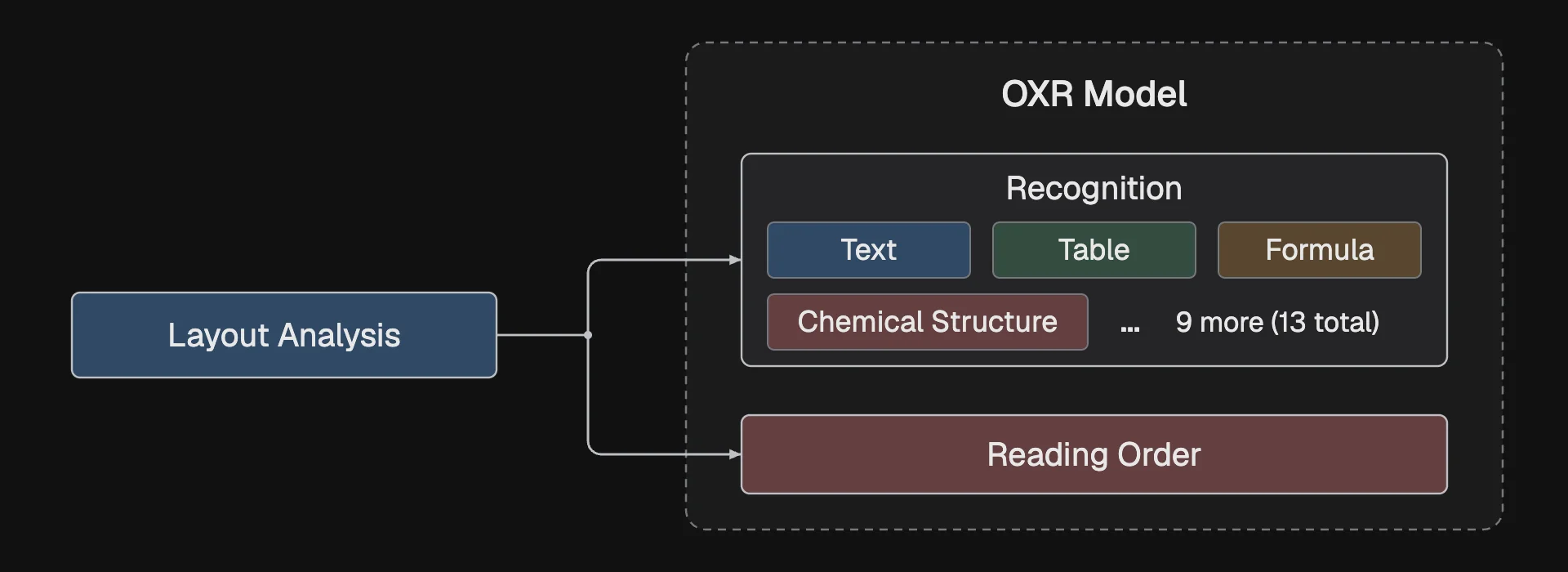
The OXR pipeline: layout analysis, then recognition and reading order in one model. Source: SoMark.
SoMark attributes OXR's accuracy and speed to two parts working together: the model architecture and a recursive self-improvement (RSI) post-training loop.
On the architecture side, layout analysis runs as a separate, replaceable model, and OXR predicts text recognition and reading order in the same pass. Teams whose documents need different regions or categories can plug in their own layout model and keep OXR's recognition and reading order. The model recognizes 13 element types, with tables output as HTML or Markdown, formulas as LaTeX, chemical equations in mhchem notation and chemical structures as SMILES.
On the training side, the RSI loop has a general vision-language model review OXR's outputs on unlabeled documents, flags unstable samples where repeated predictions disagree, and groups the likely causes with a clustering model. It then generates targeted training data that must pass rule-based checks, with no manual labeling. To the team's knowledge, OXR is the first document parser trained this way.
In SoMark's comparison against published scores, OXR ranks first on olmOCR-Bench (87.84), OmniDocBench (97.18) and DocParsingBench (87.76). In an end-to-end speed test of 21 models on the same 100 OmniDocBench pages, each on one NVIDIA RTX PRO 6000, OXR took 100.972 seconds, against 134.778 seconds for the next fastest, OvisOCR2. The evaluation setup is published in the repository.

End-to-end parsing time for 21 models on one RTX PRO 6000. Source: SoMark.
Deployment
The model is served on vLLM through an out-of-tree plugin shipped with the weights, so it works with the official vLLM Docker image or CLI without recompiling. A parsing API coordinates the model and layout services and includes a local demo page and API documentation. Weights are available on Hugging Face and ModelScope.
Availability and license
OXR is available now under a custom license based on Apache 2.0. Commercial use is free for organizations below USD 2 million in total funding or annual revenue. Above either threshold a commercial license from SoMark is required, and offering a competing hosted API is not permitted.
- GitHub: https://github.com/SoMarkAI/OXR
- Hugging Face: https://huggingface.co/SoMarkAI/OXR-1.0
- Free API and demo: https://free-oxr.somark.ai
About SoMark
SoMark is a document-parsing company headquartered in Shanghai. It builds models and APIs that turn PDFs and document images into structured data for AI applications.
Media Contact
Daisy Jiang
Email: daisy.jiang@soulcode.cn
上海市宝山区上大路668号环上大科技园0号基地317
About the author
SoMark
SoMark is a document-parsing company headquartered in Shanghai. It builds models and APIs that turn PDFs and document images into structured data for AI applications. This article is contributed by the SoMark team.
Keep reading
More from Tech Forum

SensorUp Calgary Growth Financing Closes
SensorUp Calgary's growth financing highlights strong investor confidence in the burgeoning industrial AI sector and Calgary's vibrant tech scene.
Marcus Doyle / October 21, 2026
Mecademic CAD 21M Funding Montreal Secures Expansion
Mecademic secures CAD 21M in funding, fueling Montreal-based growth, as investors support Mecademic's innovative robotics expansion plans.
Steph Moreau / October 20, 2026
Axya CAD 17M Series a Funding Montreal
Axya CAD secures $17M in Series A funding in Montreal, enhancing AI-driven procurement solutions for manufacturing industries worldwide.
Steph Moreau / October 19, 2026