Technology
Phone Charging Stations for Hospitals Keep Patients Connected
Canadian and US emergency stays now run for hours. What phone charging stations for hospitals have to get right on infection control and battery safety.
 Marcus Doyle
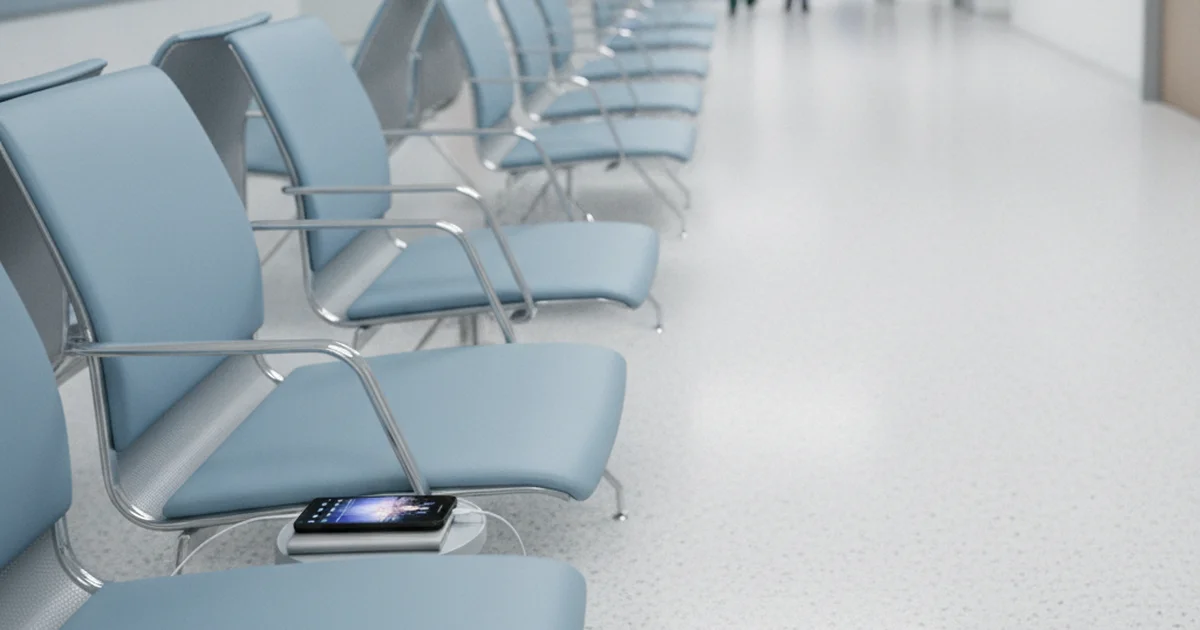
A patient admitted through a Canadian emergency department can spend most of two days there before a bed opens upstairs. For that patient, and for the family waiting in the hallway, the phone is how test results get relayed, rides get arranged, work gets told, and a worried parent in another city gets an update. When the battery dies, that line goes quiet at the worst possible moment.
Hospitals have mostly treated charging as the patient's problem. The numbers on how long people now stay, and on what lives on the surface of a phone, suggest it deserves the same planning as any other shared fixture in a clinical building.
Emergency stays are measured in hours, and sometimes days
The Canadian Institute for Health Information reports that Canadian emergency departments recorded more than 15.6 million unscheduled visits in 2025-2026. For patients who were admitted to hospital, 9 out of 10 ED visits were completed within 46.5 hours. Even for less urgent patients who were sent home, the 90th percentile was 7.8 hours.
The United States is shorter at the median but has a long tail. The CDC's National Hospital Ambulatory Medical Care Survey 2022 emergency department tables put the median wait to see a physician, nurse practitioner or physician assistant at 16.0 minutes. Waiting to be seen is only the start of the visit, though, and the survey's breakdown of total time spent in the department tells a different story.
Our analysis of the NHAMCS 2022 tables finds that about 29.0 million US emergency visits, 18.7% of the 155.4 million total, lasted six hours or longer, and 36.3% lasted at least four hours. Visits with no recorded duration were left in the denominator, so both shares are conservative.
| Time spent in the emergency department (US, 2022) | Visits (thousands) | Share of all visits |
|---|---|---|
| Less than 1 hour | 12,470 | 8.0% |
| 1 to under 2 hours | 28,612 | 18.4% |
| 2 to under 4 hours | 51,510 | 33.1% |
| 4 to under 6 hours | 27,401 | 17.6% |
| 6 to under 10 hours | 17,740 | 11.4% |
| 10 to under 14 hours | 4,584 | 2.9% |
| 14 to under 24 hours | 4,115 | 2.6% |
| 24 hours or more | 2,544 | 1.6% |
Source: CDC NCHS, NHAMCS 2022 Emergency Department Summary Tables, Table 3. Duration was blank for 4.1% of visits (6,421 thousand), not shown.

The emergency department is only the front door. Of the 17.8 million US emergency visits that ended in a hospital admission in 2022, the same survey reports a mean inpatient stay of 5.9 days (Table 24). Visitors keep those hours too.
Why the phone is not a luxury in a hospital
Pew Research Center's mobile fact sheet, based on a survey conducted from January 30 to June 18, 2026, finds that 91% of US adults own a smartphone. Among adults 65 and older, the group most likely to be admitted, the figure is 79%.
Hospitals already plan around this. London Health Sciences Centre in Ontario tells patients they may want to bring their own device and charger "to help you stay connected with family and friends, keep informed with patient education or news, and for your own entertainment." It notes that a USB charging port is available on some of its beds, and that patients without one can use their own wall adapter.
That covers an inpatient with a bed. It does not cover the visitor in a waiting room, the parent who rushed in without a cable, or the patient waiting hours on an emergency stretcher.
Infection control: a phone is a high-touch surface that travels
Phones carry bacteria, and the most-cited evidence comes from studies of clinical staff. A 2023 meta-analysis in Tropical Medicine and Health by Zenbaba and colleagues pooled 26 studies covering 2,887 healthcare workers' phones in Africa and estimated that 84.5% were contaminated with bacteria. Coagulase-negative staphylococci made up 44.0% of the pooled isolates and Staphylococcus aureus 31.3%. The authors recommend that healthcare workers disinfect their phones after use in healthcare facilities, and suggest UV-C phone sanitizers and hand-and-phone disinfection stations. The review covers staff phones in one region, not patients' or visitors' phones, so it describes a risk, not a measured rate for waiting-room devices.
What matters for a charging station is that the station itself becomes a shared touch point. The CDC's environmental cleaning guidance for healthcare facilities, written for facilities with limited resources, scores surfaces on three factors and lists "telephone" among its examples of high-touch surfaces. Applying that matrix to a shared charging kiosk is straightforward. In a lounge or waiting area (light contamination, 1) used by the general public (less susceptible, 0), a high-touch kiosk (3) scores 4. In an emergency department, which the guidance classes as heavily contaminated (3), it scores 6. Both land in the moderate-risk band, which calls for cleaning at least once daily and additionally as required.
The cleaning product matters as much as the schedule. Apple's iPhone cleaning guidance allows a 70 percent isopropyl alcohol wipe, a 75 percent ethyl alcohol wipe or Clorox Disinfecting Wipes on exterior surfaces, and says not to use products containing bleach or hydrogen peroxide. A hospital whose standard disinfectant is bleach- or peroxide-based needs to know whether the station and anything handed to patients can take it.
In a hospital, a phone charging station is an infection-control decision first and an amenity second.
Electrical and battery safety
Facilities disagree on whether personal chargers belong in clinical areas at all. LHSC lets patients use their own adapters, asks them to use the original cable and not to use a broken or frayed one, and warns about tangles and tripping. British Columbia's accreditation standard for non-hospital medical and surgical facilities goes the other way: its electrical safety standard says patient- and staff-owned electrical devices such as phone chargers are not permitted in patient care areas, and staff devices may not be charged there unless the device and power cord have been evaluated by biomedical engineering.
Portable batteries add a second question. In June 2025 the US Consumer Product Safety Commission announced the recall of about 1,158,000 Anker PowerCore 10000 power banks because the lithium-ion battery can overheat, after 19 reports of fires and explosions. A hospital has no way to know the age or recall status of the battery packs patients carry in. A managed fleet at least has a named owner who can be asked how worn or recalled units are pulled.
The options hospitals use
| Option | How it works | Infection-control point | Electrical and battery point |
|---|---|---|---|
| Bedside USB ports | Built into the bed or headwall, patient brings a cable | Patient's own cable, bed already on a cleaning schedule | Hospital-owned hardware; no help for waiting rooms |
| Patient's own wall adapter | Plugs into a room outlet | Personal item, not shared | Unknown condition of adapter and cable; some standards bar it in care areas |
| Wall-mounted multi-cable station | Tethered cables in a public area | Shared cable tips and housing are high-touch | Hospital owns and inspects one fixture |
| Charging lockers | Phone locked in a compartment while it charges | Doors and keypads are high-touch | Fixed hardware; patient is separated from the phone |
| Power bank rental kiosk | Patient takes a charged battery and keeps the phone in hand | Batteries pass between users, so between-rental cleaning matters | Operator owns battery maintenance and retirement |
The last model is the newest in clinical buildings, and it solves the problem that fixed stations cannot: a patient called back to imaging or moved to a hallway stretcher keeps both the phone and the charge. Vendors offering rental phone charging stations for hospitals and clinics describe the setup on their own sites. ChargerGoGo, for example, says each of its batteries has built-in Lightning, USB-C and Micro-USB cables, that users can rent from one station and return to any other, that its app shows the nearest station, and that each station doubles as digital signage. By its own count it has deployed more than 6,000 stations. Host venues choose between consignment, subscription and enterprise arrangements, and can offer the service as a free amenity or earn revenue from it.
Questions to settle before installing one
- Cleaning: who wipes the station, and for a rental model the batteries, how often, and with which product? Daily is the floor under the CDC scoring above.
- Compatibility: will the hospital's standard disinfectant damage the screen, the housing or the batteries?
- Biomedical sign-off: has clinical engineering reviewed the fixture and where it plugs in?
- Placement: waiting rooms and lobbies first; patient care areas only under the facility's own electrical policy.
- Battery lifecycle: how does the operator retire worn units and respond to a recall?
- Cost to the user: a paid rental suits a lobby; for long ED stays, some hospitals may prefer to cover the fee.
The data on ED stays will keep moving year to year. The basic fact will not: people spend hours in hospitals with a device that is their only link to everyone outside, and the place they charge it is one more surface the hospital is responsible for.
Methodology: US shares are calculated from visit counts in NHAMCS 2022 Table 3; the six-hour figure sums the 6 to under 10, 10 to under 14, 14 to under 24, and 24-hours-or-more bins (28,983 thousand) over all visits (155,398 thousand). Canadian figures are CIHI's published 90th percentiles for 2025-2026. Risk scores apply CDC Appendix A as written; the classification of a charging kiosk is Tech Forum's reading, not a CDC determination.
About the author
Marcus Doyle
Marcus Doyle is a Toronto-based technology writer covering cybersecurity, hardware, and supply-chain risk.
Keep reading
More from Tech Forum
Power Bank Rental in the US: How It Works and What It Costs
An eight-hour power bank rental costs $10 on ChargerGoGo's default plans, $32 on Voltage Nexus and $40 on chargeFUZE at Cosm. How US pricing works.
Marcus Yuen / November 20, 2026

Cohere Government Equity Investment Canada
The Government of Canada advances Cohere Government Equity Investment Canada with up to CAD 1.6 billion in equity from the federal government.
Marcus Doyle / November 16, 2026
Nomad AI Fleet Management Seed Funding Toronto
Toronto-based Nomad successfully closes a $2M seed funding round to enhance the Nomad AI Fleet Management platform's capabilities.
Claire Bergeron / November 9, 2026