AI
AI World Models for Game Studios: What Marble Changes
Where text-to-3D world generation fits a game pipeline in 2026: previz now, shippable assets later, and five questions before a pilot.
 Steph Moreau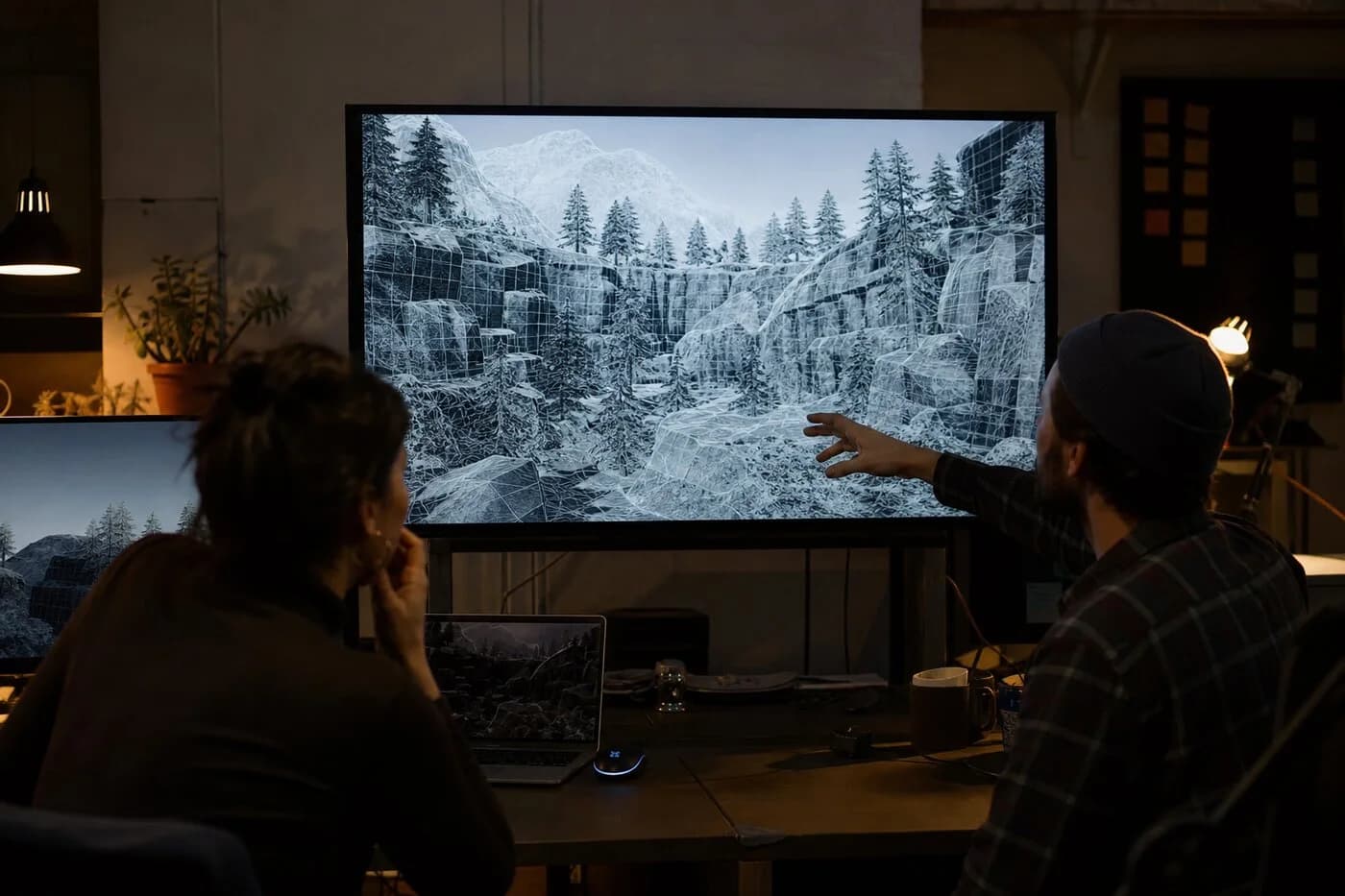
Every game producer has lived this meeting: the design doc calls for a coastal cliff level, the environment team quotes three weeks for a greybox, and the schedule dies a little. The pitch of the new "world model" generators — World Labs' Marble, Odyssey, and a wave of smaller tools — is that the greybox arrives before the meeting ends: type a paragraph, get a walkable 3D environment.
For studios, the interesting question is not whether the demos are impressive (they are) but where this fits in a production pipeline in 2026 — and where it doesn't yet.
What these tools actually output
A world model generates a persistent 3D scene from text, photos, video, or a rough layout. Unlike a video generator, the scene exists once and stays consistent as the camera moves. The practical question for a studio is the export path, and today it comes in three flavors:
| Output | What it is | Engine reality today |
|---|---|---|
| Gaussian splats | Millions of oriented color blobs | Gorgeous to look at, no native collision; needs a plugin or conversion to walk on |
| Triangle mesh | Classic geometry | Imports anywhere, but generated topology is dense and unretopologized |
| Rendered video | A flythrough clip | Previz and pitch decks only |
That table is the whole story of where world models fit right now: they are extraordinary for looking and early for shipping. A generated cliff makes a stunning previz backdrop today; making it a playable level still means a retopology and collision pass by a human. World models are currently a pre-production tool wearing a production tool's marketing.
The money says this won't stay niche
Studios should care about the funding not for gossip but because it predicts tooling investment. We compared the latest disclosed post-money valuations of the four best-funded world-model companies against their disclosed capital raised.

The multiple is the finding: investors are pricing these companies at 3 to 13 times their disclosed capital — Decart's $4 billion valuation on roughly $453 million disclosed is the high end, World Labs' $5.4 billion on $1.23 billion the largest in absolute terms. (Method: latest disclosed post-money valuation divided by sum of disclosed rounds per company, from Crunchbase News and The AI Insider reporting through June 2026.) Capital at that multiple buys engine plugins, asset-store integrations, and developer relations teams — which is exactly how a research demo becomes a button inside your editor.
Notably for this market, the backers include the companies that already sell to every studio: NVIDIA, AMD, and Autodesk all joined World Labs' February round, with Autodesk committing $200 million. Autodesk does not invest $200 million in things it expects to stay outside the Maya pipeline.
Where the workflow fits today
Talking to the tools that exist now, a realistic 2026 adoption map for a small or mid-size studio looks like this:
- Pitch and previz — use it now. A navigable mood-target of your level, generated from concept art, beats a ripomatic in every publisher meeting.
- Blockout reference — use it carefully. Generate the space, walk it in a splat viewer, then rebuild the metrics-correct greybox by hand. The generated scene answers "does this space feel right" hours earlier than a modeler can.
- Shippable environment art — not yet. Topology, LODs, collision, and performance budgets are still human work. Budget for that pass or don't promise the schedule savings.
- Virtual production and cutscenes — closer than you think. For rendered output the topology problem disappears, which is why film previz teams are adopting faster than game teams — a dynamic we covered in our earlier look at AI cutscene tools for game studios.
What you can actually try this quarter
Marble itself is generally available with a free tier, and its worlds export as splats and meshes. Around it, an ecosystem of independent applications is forming — the official Marble3D playground for text-to-3D worlds, a $10/month generator (unaffiliated with World Labs) aimed at turning single photos and prompts into walkable, exportable scenes — plus splat viewers and Unreal/Unity import plugins maturing monthly. For Canadian studios specifically, the pre-production economics matter: with Montreal and Toronto teams competing for the same publisher dollars as larger U.S. studios, cutting two weeks off every environment pitch is not a novelty, it is margin.
Five questions before you green-light a pilot
The pilots that go badly share a pattern: nobody asked the boring questions before the artists got excited. Put these in the evaluation doc:
- Who owns the world? Check the terms for commercial use of generated environments and whether outputs can train the vendor's future models. Publishers' legal teams will ask, so ask first.
- What happens to your uploads? A concept-art board or location scout photo set is confidential pre-production material. Confirm retention and training-use policies before anyone uploads a level design.
- What does splat-to-mesh actually cost? Get a real number — hours per scene, at your target density — from your own tech artist, not from the vendor's demo. This conversion is where the advertised time savings quietly leak away.
- Does it survive your perf budget? A generated scene that renders at 30 fps on a workstation tells you nothing about a Series S. Run one converted scene through your actual profiling pipeline before scaling the pilot.
- Can two people iterate on the same world? Solo generation is a demo; production is a team sport. If regenerating a region nukes a colleague's edits, the tool stays in previz.
None of these are reasons to wait — they are the difference between a pilot that produces a decision and one that produces a highlight reel.
The honest summary for a producer: world models in 2026 are where photogrammetry was around 2014 — obviously the future, awkwardly ahead of the pipeline, and worth a contained pilot on your next pitch cycle rather than a bet on your next ship date. The studios that win with them this year will be the ones that treat a generated world as a question — "is this the right space?" — and not as an asset.
About the author
Steph Moreau
Steph Moreau is a senior correspondent at Tech Forum, specializing in fintech, enterprise software, and venture capital. Her sharp analysis of funding rounds and market trends helps readers navigate Canada's evolving tech economy.
Keep reading
More from Tech Forum

Fields Medalists vs OpenAI's 722 AI Math Manuscripts
OpenAI posed ~4,000 problems to get 372 result families and published 722 manuscripts, eight days after an IAS advisory group asked labs to stop testing advanced mathematics on proprietary models.
Steph Moreau / October 7, 2026
GPT-6 Astra, iPhone Duo, $6B AI Funding: Tech's Wildest Week
GPT-6 Astra, the iPhone Duo, a complete fruit fly connectome, and $6.13B in AI funding in 48 hours: every major story from tech's most eventful week, with the numbers that matter.
Gavin Foss / September 12, 2026

Canada's Data Centre Boom Is Missing Its Electricians
US utility system construction added 76,300 jobs since 2022. Canada's lost 9,284. A matched-NAICS comparison of the trade that builds every data centre's grid connection.
Derek Fung / September 9, 2026